
Attachments & Practical Tips
Will This Attachment Fit My Excavator? A Pre-Purchase Checklist
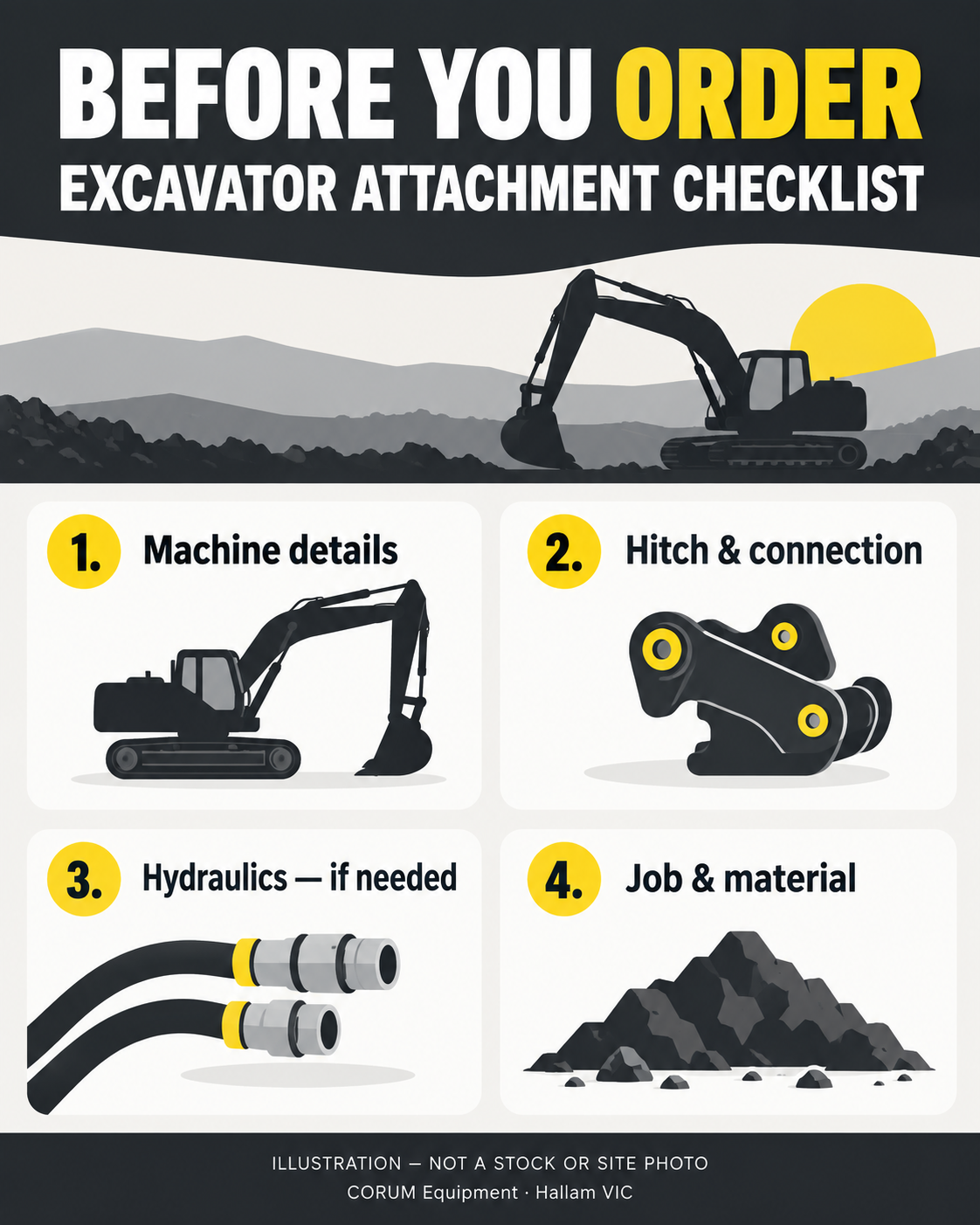
Start with your excavator model, the attachment you need and the job. Then check the connection, operating limits and hydraulic requirements where relevant.

An attachment needs to suit your excavator’s connection, operating limits and intended work. Powered attachments also need a compatible hydraulic setup. A similar machine size, or a connection that looks right in a photo, is not enough to confirm a match.
To start an enquiry, send the machine’s make and model, the attachment you need and the work you want to do. You do not need a complete technical specification sheet before contacting CORUM.
Use the checks below to prepare the information already available to you. This is a purchasing checklist, not an installation or operating procedure.
1. Start with the machine and the job
Record the make, exact model and serial number if available. A readable identification-plate photo may help, provided it can be taken safely. When buying for a fleet, identify the particular machine that will carry the attachment.
Describe the work in practical terms: the material you need to handle, trench dimensions, intended hole size or type of breaking work. Include relevant access restrictions and how frequently the attachment will be used.
Still choosing an excavator? Tell us the work and attachments you have in mind so the machine and attachment requirements can be considered together.
2. Identify the connection
Tell us whether the attachment will connect directly with pins or through a quick hitch or another coupling system. For a fitted hitch, include its manufacturer and model if known.
For common pin-mounted connections, relevant information can include the pin diameter or diameters, centre-to-centre pin spacing and the clear gap between the mounting ears. These describe different dimensions; “width” alone is not sufficiently specific. State which connection the drawing or measurements refer to—the machine-to-hitch connection or the hitch-to-attachment connection.
Use the relevant manufacturer’s drawings and specifications first. Pin dimensions are only part of the assessment: the coupling design, secure locking and movement clearances also need to suit the actual setup. Manufacturer attachment specifications and coupler information illustrate why pin dimensions and connection types must be considered together. (Geith hydraulic quick coupler specifications; WorkSafe Victoria quick hitch guidance)
Gather information safely. Do not remove pins, loosen hydraulic connections or work beneath raised or unsupported equipment just to prepare an enquiry. Where close inspection or disassembly is needed, use a competent person following the manufacturer’s instructions and the site’s isolation procedures. Switching off the engine alone does not necessarily control stored hydraulic energy or gravity hazards. (WorkSafe Victoria plant isolation guidance)
3. Check hydraulics only where relevant
Hydraulically powered tools—such as auger drives, breakers and hydraulic thumbs—need their requirements checked against the machine’s actual auxiliary circuit. A mechanical thumb is not the same as a hydraulic thumb and does not automatically have the same hydraulic requirements. (Gentec mechanical thumb information; Digga mini excavator auger drives; Digga two-speed high-flow auger drives (15–22 t))
Useful information includes the auxiliary flow and pressure specified for that machine and configuration, the hydraulic connection type and the supply and return arrangements. A separate case drain or particular circuit setup may be required for some tools; use the requirements for the exact attachment, not a general rule for its category. (Digga mini excavator auger drives; Digga two-speed high-flow auger drives (15–22 t))
Do not substitute a brochure’s main-pump figure for confirmed attachment-circuit information. Manufacturer specifications may distinguish pump capacity from auxiliary flow, and the installed setup still needs checking. (Bobcat E08 specifications)
If the information is missing, send the relevant manual page or explain what is unknown. There is no need to guess a pressure, disconnect a hose or carry out a hydraulic test to start an enquiry.
4. Check more than physical fit
Matching pin geometry is not the whole decision. The attachment and hitch weight, the machine’s permitted operating limits and the work involved also need to be considered. A physically attachable tool still needs to be an appropriate choice for that machine and task. (Geith hydraulic quick coupler specifications; WorkSafe Victoria quick hitch guidance)
For digging work, explain the material, required width and intended use. For drilling, describe the ground and hole dimensions. For breaking, describe the material and scale of work rather than assuming any breaker will suit.
Photos can help identify the setup, but they are not a substitute for the applicable specifications, manufacturer requirements and any physical checks needed before use.
What to send CORUM
Start with
- The machine make and model.
- The attachment you need.
- A short description of the job.
Add what you already have
- Serial number and safely taken identification or connection photos.
- Hitch make and model, relevant drawings or confirmed dimensions.
- Auxiliary-hydraulic documentation where the attachment needs it.
- Your location and preferred timing.
CORUM can help compare and source attachment options against the machine and application. Fitment, specification and availability are confirmed before supply. (CORUM Attachments & Parts)
Email sales@corumequipment.com.au with your starting details. We’ll explain what else needs checking.
CORUM Equipment · Hallam VIC
Related guidance
For access planning, read Will a Mini Excavator Fit Through Your Side Gate?.
You can also review the attachments and parts categories CORUM can help source. That overview is not a model-specific compatibility table.
Sources & further reading
- Geith: Hydraulic Quick Coupler — connection dimensions, pin-centre range, coupling design and coupler weight. Used as an example of manufacturer requirements, not as a CORUM compatibility claim. Geith hydraulic quick coupler specifications
- WorkSafe Victoria: Semi-automatic quick hitches on excavators — matching machines, attachments and hitches; using retention systems and following manufacturer instructions. General safety principles only; this article does not certify compliance with any standard. WorkSafe Victoria quick hitch guidance
- WorkSafe Victoria: Isolate, de-energise, lockout and tagout plant — inspections, isolation and stored-energy hazards. WorkSafe Victoria plant isolation guidance
- Gentec: Weld-On Mechanical Thumbs — an example of mechanical thumbs that do not require added hydraulics. Not a CORUM stock or product recommendation. Gentec mechanical thumb information
- Digga: Auger Drives for Mini Excavators 2–5 t and 2 Speed High Flow Auger Drives 15–22 t — examples showing attachment-specific flow, pressure and case-drain requirements. Do not transfer their numerical specifications to a different attachment. Digga mini excavator auger drives Digga two-speed high-flow auger drives (15–22 t)
- Bobcat: E08 Mini Excavator specifications — example distinguishing pump capacity and auxiliary flow. Not a specification for a CORUM model. Bobcat E08 specifications
- CORUM: Attachments & Parts — published sourcing categories and conditional fitment and availability support. CORUM Attachments & Parts
Sources checked